


 Inquiries by Email
 WhatsApp Reservation

The leading knee replacement alternatives in 2026 are stem cell therapy (ADSCs), platelet-rich plasma (PRP), and hyaluronic acid (HA) — chosen by Kellgren-Lawrence (KL) osteoarthritis grade. Stem cell therapy carries the strongest 2025 meta-analytic evidence for KL Grade I–III; PRP outperforms HA but underperforms stem cells in head-to-head data; HA suits short-term symptom relief; total knee replacement (TKA) remains the gold standard for bone-on-bone Grade IV disease, with a 10% patient dissatisfaction rate.
At Cell Grand Clinic in Osaka, Japan, up to 100 million stem cells are cultured over 7 weeks from your own minimal fat tissue — never donor cells.
Key statistics
- More than 650 million people aged 40 and older worldwide are affected by osteoarthritis, according to the 2025 meta-analysis published in Stem Cell Research & Therapy (Cao et al. 2025).
- 33% of individuals over 75 have symptomatic and radiographic knee OA, per the 2021 review published in JAMA (Katz, Arant, and Loeser 2021).
- More than 1 million knee replacements are performed annually in the United States, according to the 2022 systematic review in The Journal of Arthroplasty (DeFrance and Scuderi 2022).
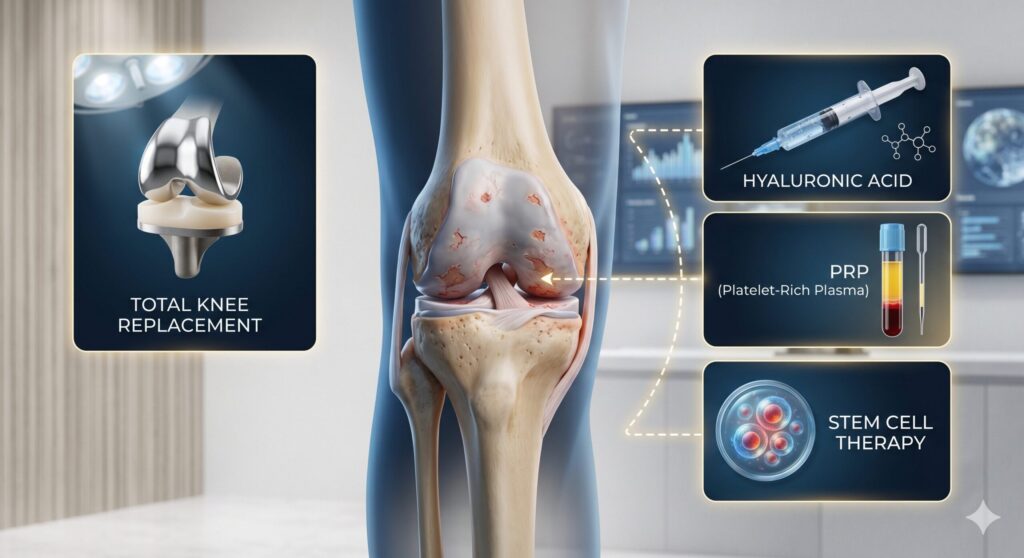
- Knee Replacement Alternatives at a Glance: Stem Cell, PRP, Hyaluronic Acid, and Lifestyle
- What Knee Osteoarthritis Really Is — And Why It Gets Worse
- How to Choose: Decision Tree by Kellgren-Lawrence Osteoarthritis Grade (I, II, III, IV)
- Total Knee Replacement (TKA) vs Alternatives: When Surgery Is Still the Right Choice
- Hyaluronic Acid (HA) Knee Injection: Best Use Case and Why It’s Not Enough Alone
- PRP vs Stem Cell for Knees: Which Regenerative Treatment Works Better for Cartilage?
- Stem Cell Therapy as a Knee Replacement Alternative: When It Makes Sense
- Stem Cell vs PRP vs HA vs Knee Replacement: 2026 Side-by-Side Comparison Table
- Knee Replacement Alternatives for Bone-on-Bone (KL Grade IV): Realistic Options
- Am I a Candidate for a Non-Surgical Knee Replacement Alternative?
- When to See a Knee Specialist Instead of Self-Selecting Treatment
- Why Japan, and Why Cell Grand Clinic
- Postpone the knee replacement — repair the cartilage first.
- Frequently Asked Questions: Knee Replacement Alternatives
- Postpone the knee replacement — repair the cartilage first.
- References
Knee Replacement Alternatives at a Glance: Stem Cell, PRP, Hyaluronic Acid, and Lifestyle
▶ The main non-surgical alternatives to knee replacement are stem cell therapy (most often using adipose-derived MSCs), platelet-rich plasma (PRP), hyaluronic acid (HA), and lifestyle interventions (weight loss, targeted exercise). Each works through a different biological mechanism, fits a different stage of osteoarthritis, and carries different evidence.
Lifestyle measures support every other option at every stage. The right choice depends on how advanced your osteoarthritis is, what you have already tried, and whether you want to delay or avoid surgery.
A 2021 JAMA review by Katz, Arant, and Loeser described knee osteoarthritis as a leading global cause of disability, with symptoms typically worsening over years rather than months — meaning most patients have a meaningful window of time to consider both surgical and non-surgical options before the joint reaches an end-stage. Source: Katz JN, Arant KR, Loeser RF. JAMA. 2021;325(6):568-578. https://doi.org/10.1001/jama.2020.22171
What Knee Osteoarthritis Really Is — And Why It Gets Worse
Knee osteoarthritis (OA) is a slow, progressive disease in which the cartilage that cushions the joint breaks down, the underlying bone thickens, and inflammation spreads through the joint lining. The result is pain, stiffness, swelling, and eventually difficulty walking. It is the single most common cause of chronic knee pain in adults over 50.
A 2021 JAMA review published in JAMA described knee OA as one of the leading global causes of disability, with symptoms typically worsening over years rather than months — meaning most patients have a meaningful window of time to consider both surgical and non-surgical options before the joint reaches an end stage. The same review emphasized that no drug has yet been shown to stop or reverse the underlying cartilage loss; current medications mainly manage pain.
Meniscus tears, often caused by a twisting injury or by gradual wear, make things worse by removing the shock-absorbing cushion between the femur and tibia. Both conditions — OA and meniscus damage — share the same fundamental problem: the joint’s repair capacity is lim
How to Choose: Decision Tree by Kellgren-Lawrence Osteoarthritis Grade (I, II, III, IV)
▶ Choose your knee treatment by Kellgren-Lawrence (KL) Grade: Grade I–II responds best to stem cell therapy or PRP combined with lifestyle changes; Grade III is the strongest window for stem cell therapy; Grade IV (bone-on-bone) usually requires total knee replacement, with stem cells used adjunctively in select cases. Hyaluronic acid offers short-term symptom relief at any grade.
This is the single most important framework — the same treatment that works at Grade II may not work at Grade IV.
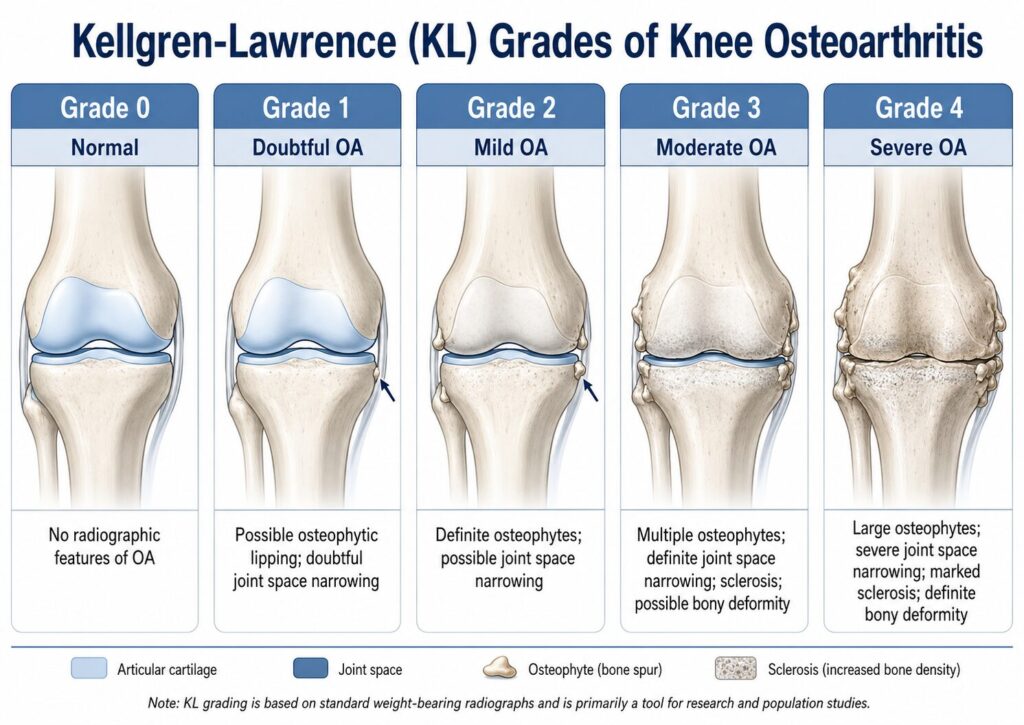
| KL Grade | Joint State | First-Line Alternative | Stem Cell Role | When TKA Is Better |
|---|---|---|---|---|
| I (Mild) | Possible osteophytes, minimal narrowing | Lifestyle + PRP | Preventive / pain control | Rare |
| II (Mild-Moderate) | Definite osteophytes, possible narrowing | Stem cell therapy or PRP | First-line non-surgical option | Rare |
| III (Moderate) | Multiple osteophytes, definite narrowing, sclerosis | Stem cell therapy | Strongest evidence window | If failed prior treatments |
| IV (Severe / Bone-on-Bone) | Large osteophytes, severe narrowing, deformity | Total Knee Replacement (TKA) | Adjunctive / for non-surgical candidates only | First choice for most patients |
Kellgren-Lawrence grading is the standard X-ray-based severity classification for knee OA. KL Grade determines the strongest treatment match.
KL Grade I-II: Early-Stage Knee OA — Best Non-Surgical Options
At Grade I-II, the cartilage is thinning but the joint structure is preserved — this is the window where non-surgical regenerative treatments have the best long-term outcomes. The 2025 systematic review and meta-analysis published in Stem Cell Research & Therapy (Cao et al. 2025) analyzed 8 RCTs of 502 patients and confirmed mesenchymal stem cell injection produces significant WOMAC improvement at 6 months (MD=7.44, 95%CI 1.45–13.42, P=0.01) and 12 months (MD=10.31, 95%CI 0.96–19.67, P=0.03) in knee OA.
Combining stem cell therapy with weight management and targeted exercise typically delivers the best outcome.
KL Grade III: Moderate Knee OA — When Stem Cells Lead
At Grade III, stem cell therapy is the leading non-surgical option because the joint still has cartilage to repair but symptoms have outgrown HA and PRP. A 2016 dose-escalation The 2025 systematic review and meta-analysis published in Stem Cell Research & Therapy (Cao et al. 2025) analyzed 8 RCTs of 502 patients
Patients at Grade III who delay surgery successfully with stem cell therapy typically gain 2–5 additional years before considering TKA.
Our own medical director published a peer-reviewed case report (Cureus, 2026) on a KL Grade III knee treated with adipose-derived stem cells — pain (VAS) 8→0 and function (JOA) 55→95 over 13 months, in a patient who declined total knee replacement. See the full case on our stem cell therapy page →
Knee Osteoarthritis: A Non-Surgical Path with Stem Cells Read ArticleKL Grade IV (Bone-on-Bone): Are Knee Replacement Alternatives Still Realistic?
At Grade IV, total knee replacement is usually the right choice — stem cell therapy will not rebuild a lost joint surface. However, stem cells still offer meaningful pain and function relief for patients who cannot undergo surgery because of age, comorbidities, anticoagulation, or personal preference. For patients who want to delay TKA by 1–2 years, ADSC therapy remains a meaningful tool.
Total Knee Replacement (TKA) vs Alternatives: When Surgery Is Still the Right Choice
▶ Total knee replacement (TKA) is the gold standard for end-stage, bone-on-bone knee osteoarthritis — and a 2022 systematic review re-examining the long-cited ‘20% dissatisfaction rate’ found that the actual rate is approximately 10%, with periprosthetic joint infection occurring in approximately 1.08% of cases.
Trade-offs are real: 3 to 5 days of hospitalization, 4 to 12 weeks of intensive rehabilitation before returning to normal activity, and 15–20 years of implant longevity — younger patients may face a revision surgery later in life, which is technically more difficult than the original operation.
Key evidence: A 2022 systematic review of 21 studies found average patient dissatisfaction after TKA was 10% (7.3% excluding complications), notably lower than the historically reported 20%.
Periprosthetic joint infection (PJI) occurred in approximately 1.08% of primary TKA cases in a 2024 global meta-analysis.
When TKA is clearly the right choice:
- Severe deformity (varus or valgus malalignment)
- Bone-on-bone contact visible on weight-bearing X-ray
- Functional limitation (cannot walk 1 block, climb stairs, sleep through pain)
- Failed conservative treatments over 6–12 months
- Stable medical condition for general anesthesia
When alternatives deserve serious consideration first:
- KL Grade I–III (cartilage is still present)
- Age under 60 (implant revision risk in 15–20 years)
- Athletic or active lifestyle priorities
- Bilateral disease (delaying one knee by years matters)
- Medical contraindications to surgery

Hyaluronic Acid (HA) Knee Injection: Best Use Case and Why It’s Not Enough Alone
▶ Hyaluronic acid is a viscous joint fluid supplement that lubricates the knee for weeks to months — useful for mild-to-moderate symptoms but it does not repair cartilage or change the underlying disease.
A 2021 randomized clinical trial (n=200 in final analysis) in BMC Musculoskeletal Disorders compared HA, PRP, PRGF, and ozone injections in knee OA over 12 months. While all groups improved short-term, by 12 months only the PRP and PRGF groups maintained better outcomes than HA and ozone — meaning the platelet-based options were more durable than HA alone.
HA’s main strength is its safety profile and minimal downtime — risks are small and the procedure is quick. Its main limitation is that it is purely symptomatic: after the fluid is absorbed, nothing structural has changed.
Best use case for HA: mild Grade I–II OA, patients who want to try the simplest option first, or short-term symptom relief during a brief activity window (a trip, an event, returning to sport for a season).
Genicular Artery Embolization (GAE): Where It Fits
Genicular artery embolization (GAE) is a newer, minimally invasive procedure performed by an interventional radiologist that reduces abnormal blood flow to the inflamed lining of an arthritic knee, aiming to lower pain. Like hyaluronic acid, GAE is symptomatic — it targets pain and inflammation rather than repairing cartilage — and the current evidence is still emerging, with sham-controlled trials showing mixed durability. It may suit mild-to-moderate osteoarthritis in patients who want a non-surgical option but are not candidates for, or not interested in, regenerative (cell-based) treatment.
PRP vs Stem Cell for Knees: Which Regenerative Treatment Works Better for Cartilage?
▶ PRP outperforms hyaluronic acid and corticosteroids for knee OA in network meta-analyses, but stem cell therapy carries the broadest 2025 meta-analytic evidence (502 patients, 8 RCTs) for sustained WOMAC improvement at 12 months — making stem cells the strongest non-surgical biologic option for KL Grade II–III.
The key biological difference: PRP delivers growth factors from your own blood platelets over hours-to-days, while stem cell therapy uses living mesenchymal stem cells (most often from your own fat) that continue releasing anti-inflammatory and repair signals for weeks.
Side-by-Side: PRP vs Stem Cell for Knees
| Factor | PRP | Stem Cell Therapy (ADSC) |
|---|---|---|
| Mechanism | Growth factors from platelets | Living MSCs releasing growth factors + anti-inflammatory cytokines for weeks |
| Active duration in joint | Hours to days | Weeks |
| Evidence grade for knee OA | Mixed (Qiao 2023 favorable vs HA/CSC; RESTORE trial negative vs placebo) | Strong (Cao 2025 meta: 8 RCTs, 502 patients, significant WOMAC at 6 & 12 mo) |
| Effect size vs placebo | Modest, may shrink in blinded trials | Significant at 6 and 12 months (Cao 2025) |
| Best KL Grade fit | I-II | II-III |
| Cost | Lower (typically 1/3 to 1/5 of stem cells) | Higher |
| Recovery | Same-day return to light activity | Same-day return to light activity |
| Repeat frequency | Often 3 injections per series | Single injection of high-dose (≥100M cells) |
Sources: Cao M et al. Stem Cell Res Ther 2025;16(1):122 (MSC meta) and Bennell KL et al. JAMA 2021;326(20):2021-2030 (RESTORE PRP trial). Cost ranges reflect global ballpark estimates and vary by country and clinic.
The JAMA 2021 RESTORE trial found PRP did not produce significantly greater symptomatic or structural benefit than placebo saline injection in knee OA at 12 months — a finding that recalibrated expectations for PRP as a disease-modifying therapy.
A 2023 network meta-analysis in BMC Musculoskeletal Disorders (35 studies, 3,104 patients) found PRP and PRP+HA produced the best WOMAC and VAS outcomes at 3, 6, and 12 months compared with hyaluronic acid or corticosteroids alone, with no increase in adverse events.
Practical bottom line: If cost is a constraint and your OA is early-stage (KL I-II), start with PRP. If you need the strongest biological option, want to delay surgery, or have KL III disease, stem cell therapy carries the broadest 2025 evidence base.
Stem Cell Therapy as a Knee Replacement Alternative: When It Makes Sense
▶ Stem cell therapy is the leading non-surgical alternative to knee replacement in 2026 — best suited for KL Grade I–III osteoarthritis, with a 2025 meta-analysis of 502 patients confirming significant WOMAC improvement at 6 and 12 months.
Adipose-derived mesenchymal stem cells (ADSCs) are the most studied source for knee OA because they are easier to harvest in large numbers, produce stronger anti-inflammatory signals than bone-marrow MSCs in joint trials, and avoid the donor-site morbidity of bone marrow aspiration.
What the Research Shows: Stem Cells vs Knee Replacement
▶ The strongest current research on stem cells as a knee replacement alternative is a 2025 meta-analysis of 8 randomized trials (502 patients) published in Stem Cell Research & Therapy (Cao et al. 2025), which found significant WOMAC pain and function improvement at 6 and 12 months for KL Grade I–III osteoarthritis. For platelet-based therapy, the 2021 RESTORE trial in JAMA (Bennell et al.) found PRP no better than placebo for joint structure — which is why stem cell therapy, not PRP, carries the broader evidence base as a knee-replacement-sparing option. The research does not support stem cells rebuilding a bone-on-bone (KL Grade IV) joint.
For the complete clinical guide — including the 4 mechanisms of cartilage repair, KL-grade-specific outcomes, dose-response data, ADSC vs BMAC comparison, MHLW regulation in Japan, and the full Cell Grand Clinic treatment protocol — see our Pillar article:
Knee Osteoarthritis: A Non-Surgical Path with Stem Cells Read ArticleFor the meniscus repair pathway, see:
Torn Meniscus Without Surgery: A Stem Cell Treatment Option Read Article
Stem Cell vs PRP vs HA vs Knee Replacement: 2026 Side-by-Side Comparison Table
▶ This is the master comparison: at a glance, here is how each knee treatment compares on cost, recovery, evidence, and the KL Grade it fits best.
| Factor | Hyaluronic Acid (HA) | PRP | Stem Cell Therapy (ADSC) | TKA (Surgery) |
|---|---|---|---|---|
| What it is | Joint lubricant | Platelet growth factors | Living MSCs (autologous) | Surgical joint resurfacing |
| Approach | Symptom relief | Symptom + mild repair signal | Anti-inflammatory + repair signaling | Joint replacement |
| Best KL Grade fit | I–II | I–II | II–III (some IV) | III–IV |
| Evidence (2026) | Modest, short (Raeissadat 2021) | Mixed (Qiao 2023 favorable; RESTORE negative vs placebo) | Strong (Cao 2025 meta, 502 pts) | Gold standard end-stage |
| Effect duration | Weeks-months | Months | 12+ months documented | 15–20 years (implant) |
| Cost (USD, est.) | $300–$1,000 | $500–$2,500 | $15,000–$40,000 | $30,000–$60,000 (US) |
| Recovery | Same day | Same day | Same day (light activity) | 3–5 day hospital, 4–12 wk rehab |
| Serious risk | Very low | Very low | Very low (autologous) | ~1.08% deep infection (Ma 2024) |
| Anesthesia | None | None | None (local for fat harvest) | General or spinal |
Cost ranges reflect global ballpark estimates and vary by country and clinic. Cell Grand Clinic’s autologous ADSC treatment is delivered under Japan’s MHLW Type 2 certification framework (Act on the Safety of Regenerative Medicine).
Knee Replacement Alternatives for Bone-on-Bone (KL Grade IV): Realistic Options
▶ At KL Grade IV — true bone-on-bone osteoarthritis with severe joint deformity — total knee replacement (TKA) is the right answer for the majority of patients, but realistic alternatives exist for those who cannot or choose not to undergo surgery.
The honest assessment: stem cell therapy will not rebuild a lost cartilage surface or correct severe varus/valgus deformity. What it can offer is meaningful pain reduction and functional improvement in patients for whom surgery carries unacceptable risk.
Realistic options at Grade IV:
- Stem cell therapy as pain-management bridge — for patients with cardiac, anticoagulation, or age-related surgical risk who need 1–2 years of additional time before TKA, or who refuse surgery entirely.
- Stem cell therapy combined with high tibial osteotomy (HTO) — a 2024 randomized trial in the Journal of Translational Medicine (n=45) found autologous ADSC + HTO significantly reduced knee OA severity vs HTO alone, with outcomes correlated with stem cell stemness markers. Source: Sun H, Zhai H, Han K et al. J Transl Med. 2024;22(1):1039. https://doi.org/10.1186/s12967-024-05814-3
- Aggressive lifestyle modification + bracing + assistive devices — may delay surgery by months to a year in motivated patients.
- Partial knee replacement (UKA) for select Grade IV — if disease is limited to one compartment.
What stem cells cannot do at Grade IV: regrow a collapsed joint, correct deformity, restore a 20-year-old knee. Patients who pursue stem cell therapy at Grade IV should set realistic expectations of pain reduction and functional improvement, not joint restoration.
Am I a Candidate for a Non-Surgical Knee Replacement Alternative?
▶ You may be a candidate for stem cell therapy or PRP as a knee replacement alternative if you meet most of the following. This is a general framework, not a substitute for a medical consultation.
- Diagnosed with knee osteoarthritis (typically KL Grade I–IV) or persistent post-procedure knee pain
- Hyaluronic acid, steroid injections, or PRP no longer give lasting relief
- Want to avoid or delay total knee replacement, or are not ready for major surgery
- Looking for a treatment that targets the joint biology, not only the pain
- Generally healthy enough for a minimally invasive fat harvest and intra-articular injection
- Realistic about outcomes — pain and function improvement, not new joint
You may not be a candidate if:
- End-stage Grade IV with severe deformity and you are a surgical candidate (TKA is likely better)
- Active joint infection (must resolve first)
- Active cancer treatment (consult oncology)
- Severe coagulation disorder uncontrolled by anticoagulation
- Very limited life expectancy where benefits cannot accrue over months
When to See a Knee Specialist Instead of Self-Selecting Treatment
▶ Knee pain that lasts more than 6 weeks, causes a visible limp, prevents sleep, or follows trauma should be evaluated by a knee specialist — not self-managed.
Imaging (weight-bearing X-ray, sometimes MRI) is essential before choosing any treatment, because the right alternative depends entirely on what your joint actually shows. Self-selecting stem cell therapy without imaging is a common mistake.
A specialist consultation should include:
- Weight-bearing X-ray to assess KL Grade
- MRI if meniscus injury or cartilage flap is suspected
- Physical exam (range of motion, alignment, ligament stability)
- Review of prior treatments and their durations
- Honest discussion of which treatment fits your KL Grade and goals
Why Japan, and Why Cell Grand Clinic
Japan is one of the few countries in the world where regenerative medicine is regulated directly by the national government. Under the Act on the Safety of Regenerative Medicine, every clinic providing cell-based therapy must be certified by the Ministry of Health, Labour and Welfare (MHLW), the equivalent of the FDA. This is not a voluntary accreditation; it is a legal requirement with government oversight of cell handling, facility standards, and informed consent.

Cell Grand Clinic operates within this framework. Treatments use the patient’s own adipose-derived stem cells (autologous ADSCs), processed in a CPC-grade (Cell Processing Center) laboratory, under a physician with NIH training and experience across more than 3,000 patient cases.
| Factor | Japan (MHLW-certified) | Mexico | Thailand |
|---|---|---|---|
| Government Oversight | MHLW certified ✓ | Limited regulation | Emerging regulation |
| Cell Quality Standards | CPC-grade, 7-week culture ✓ | Varies by clinic | Varies by clinic |
| Cell Count per Treatment | Up to 200 million ✓ | Varies | Varies |
| Cell Source | Autologous (patient’s own) ✓ | Often allogeneic | Mixed |
| Physician Credentials | NIH-trained MD ✓ | Varies | Varies |
Comparison is based on general regulatory frameworks. Individual clinics may vary. Japan’s MHLW certification is unique in providing government-level oversight for regenerative treatments.
Grand Stem Cell — Four Quality Standards
Beyond the regulatory framework, Cell Grand Clinic’s cells are prepared under a four-standard quality program branded Grand Stem Cell. Each patient’s cells must meet all four before they are used.
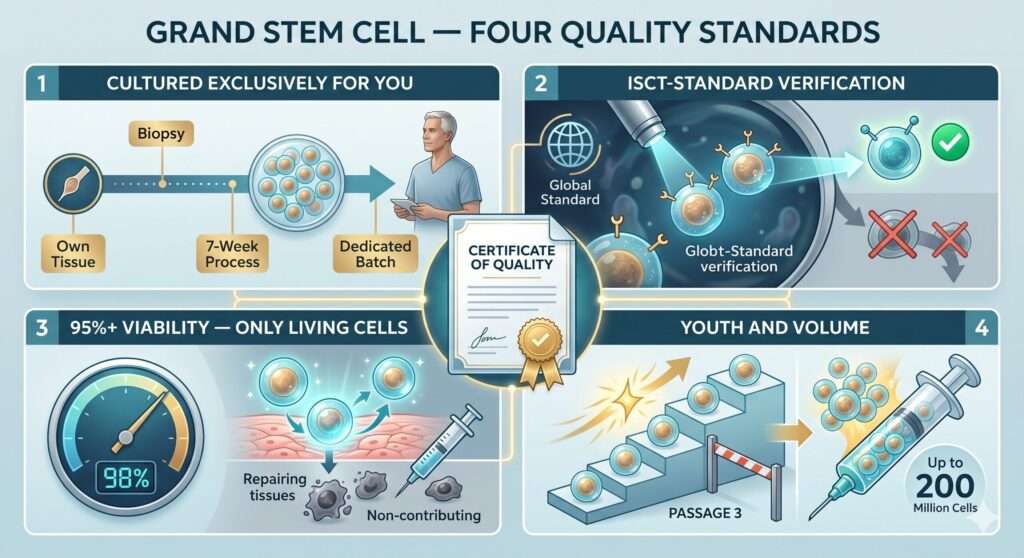
- Cultured Exclusively for You. Grand Stem Cells are never stocked and never pooled. Cells are expanded from the patient’s own tissue over a seven-week culture process, with every batch dedicated to one patient only.
- ISCT-Standard Verification. Surface-marker testing follows the global standard of the International Society for Cell & Gene Therapy (ISCT). Cells that do not meet the defining mesenchymal stem cell criteria are discarded, not delivered.
- 95%+ Viability — Only Living Cells. Dead or degraded cells do not contribute to repair. Viability is verified at greater than 95% immediately before administration, with quality control continuing up to the moment of injection.
- Youth and Volume, Without Compromise. Stem cells age with each passage. Grand Stem Cells are strictly limited to Passage 3 or below, while scaling up to as many as 200 million cells per treatment — preserving regenerative capacity without sacrificing dose.
Every patient at Cell Grand Clinic receives a Certificate of Quality documenting that their Grand Stem Cells met all four standards before administration.
Cell Quality: The Key Factor That Impacts Stem Cell Therapy Outcomes Learn MorePostpone the knee replacement — repair the cartilage first.
Stem cell therapy — from $19,800 USD per session
$19,800 USD includes:
- 100 million autologous ADSCs
- 7-week culture at MHLW-certified CPC · passage ≤3
- Quality certificate · 95%+ viability
- 1 / 3 / 6 month remote follow-up
Final pricing depends on your individual case:
- Combination protocols
- Multiple sessions
Have Dr. Wakabayashi review your case.
Share your medical history and current treatments. Dr. Wakabayashi reviews each international inquiry and responds with a written feasibility note, recommended protocol, and quote. Typical turnaround: 1–3 business days.
Frequently Asked Questions: Knee Replacement Alternatives
Is stem cell therapy a real alternative to knee replacement?
Yes — stem cell therapy is the strongest non-surgical alternative in 2026 for KL Grade I-III osteoarthritis, with a 2025 meta-analysis of 502 patients confirming significant WOMAC pain and function improvement at 6 and 12 months (Cao M et al. Stem Cell Res Ther. 2025;16(1):122). For end-stage Grade IV bone-on-bone arthritis where surgery is feasible, TKA remains the gold standard.
How does stem cell therapy compare to PRP for knees?
Stem cell therapy carries broader 2025 meta-analytic evidence than PRP. PRP delivers growth factors from blood platelets over hours-to-days, while stem cells release anti-inflammatory and repair signals for weeks. PRP remains a reasonable lower-cost option for KL Grade I-II disease.
Is hyaluronic acid still worth trying for knee OA?
Yes, but with realistic expectations. Hyaluronic acid can reduce knee pain for weeks to months in mild osteoarthritis and is a low-risk procedure. In a 2021 direct-comparison RCT, HA showed less durable effects than PRP or PRGF at 12 months (Raeissadat SA et al. BMC Musculoskelet Disord. 2021;22(1):134). It is a reasonable starting point for KL Grade I, not a final answer.
When should I consider total knee replacement instead?
Consider TKA when you have KL Grade IV bone-on-bone arthritis with severe deformity, when you cannot walk one block or climb stairs, when sleep is disturbed by pain, and after at least 6-12 months of failed conservative treatment. The 10% dissatisfaction rate (DeFrance 2022) and 1.08% serious infection risk (Ma 2024) are real and worth understanding.
What are the risks of regenerative knee treatments?
The most common risks are mild transient pain or swelling at the injection site, lasting 24-72 hours. Serious risks are very rare with autologous (your own) cells handled under sterile conditions. Donor stem cells from unregulated overseas clinics carry additional risks of contamination and inconsistent dosing.
How soon will I feel a difference after stem cell treatment?
Most patients begin noticing reduced pain at 4-8 weeks, with peak improvement at 3-6 months and durability documented to 12 months or longer in the 2025 Cao meta-analysis. The biological process — cells migrating, releasing signals, modulating inflammation — unfolds over weeks, not days.
Which regenerative treatment has the best safety profile and downtime?
Hyaluronic acid has the simplest safety profile (mild local reaction only) and zero recovery time, but only short-term symptom relief. Autologous stem cell therapy from your own fat has very low serious complication rates (no donor-tissue rejection) and only requires avoiding high-impact activities for several weeks. For best safety-to-effect ratio in KL Grade II-III, autologous stem cell therapy under MHLW oversight is the strongest balance.
What are the alternatives to PRP for knees?
If PRP has not given you lasting relief, the main alternatives for knee osteoarthritis are stem cell therapy (adipose-derived MSCs — a stronger, longer-acting biologic with broader 2025 meta-analytic support), hyaluronic acid (short-term lubrication only), corticosteroid injections (fast but short-lived, and repeated use can accelerate cartilage loss), and non-injection measures like weight management and targeted exercise. For KL Grade II–III disease, stem cell therapy carries the strongest evidence of the injectable options; for early KL Grade I, PRP or HA may still be reasonable first steps.
How many years can stem cell therapy delay a knee replacement?
There is no guaranteed number, but for patients with KL Grade III osteoarthritis who respond well, stem cell therapy is commonly used to postpone total knee replacement by roughly 2–5 years while managing pain and function. It is not a permanent substitute: once the joint reaches bone-on-bone (KL Grade IV) with deformity, stem cells cannot rebuild the surface and surgery is usually the better choice. The goal is to buy good-quality time, especially for younger and active patients who want to avoid an early implant and a later revision.
Does stem cell therapy really work for knees?
The best current evidence is a 2025 meta-analysis of 8 randomized trials (502 patients) in Stem Cell Research & Therapy, which found significant improvement in knee pain and function (WOMAC) at 6 and 12 months, with the strongest results in KL Grade I–III osteoarthritis. It is not a cure and will not regrow a bone-on-bone joint, but for the right candidate it is currently the injectable option with the broadest supporting data. Outcomes depend on disease stage, cell dose and quality, and the experience of the treating physician.
Postpone the knee replacement — repair the cartilage first.
Cell Grand Clinic in Osaka, Japan is one of the world’s leading clinics for autologous adipose-derived stem cell (ADSC) therapy for knee osteoarthritis. Dr. Yuichi Wakabayashi (American Board of Regenerative Medicine, NIH-trained, 3,000+ stem cell cases across ~20 countries) personally manages every step under MHLW government oversight, with up to 100 million quality-verified cells per treatment.
References
All references verified via PubMed API on 2026-05-25. DOI links per PubMed attribution requirements.
- Katz JN, Arant KR, Loeser RF. Diagnosis and Treatment of Hip and Knee Osteoarthritis: A Review. JAMA. 2021;325(6):568-578. https://doi.org/10.1001/jama.2020.22171 (PMID 33560326)
- DeFrance MJ, Scuderi GR. Are 20% of Patients Actually Dissatisfied Following Total Knee Arthroplasty? A Systematic Review. J Arthroplasty. 2023;38(3):594-599. https://doi.org/10.1016/j.arth.2022.10.011 (PMID 36252743)
- Ma T, Jiao J, Guo DW et al. Incidence of periprosthetic joint infection after primary total knee arthroplasty shows significant variation. J Orthop Surg Res. 2024;19(1):649. https://doi.org/10.1186/s13018-024-05099-8 (PMID 39396015)
- Raeissadat SA, Ghazi Hosseini P, Bahrami MH et al. The comparison effects of intra-articular injection of PRP, PRGF, HA, and ozone in knee osteoarthritis. BMC Musculoskelet Disord. 2021;22(1):134. https://doi.org/10.1186/s12891-021-04017-x (PMID 33536010)
- Bennell KL, Paterson KL, Metcalf BR et al. Effect of Intra-articular Platelet-Rich Plasma vs Placebo Injection. JAMA. 2021;326(20):2021-2030. https://doi.org/10.1001/jama.2021.19415 (PMID 34812863) [RESTORE trial]
- Qiao X, Yan L, Feng Y et al. Efficacy and safety of corticosteroids, HA, and PRP combination therapy: network meta-analysis. BMC Musculoskelet Disord. 2023;24(1):926. https://doi.org/10.1186/s12891-023-06925-6 (PMID 38037038)
- Cao M, Ou Z, Sheng R et al. Efficacy and safety of mesenchymal stem cells in knee osteoarthritis: meta-analysis. Stem Cell Res Ther. 2025;16(1):122. https://doi.org/10.1186/s13287-025-04252-2 (PMID 40055739)
- Pers YM, Rackwitz L, Ferreira R et al. Adipose Mesenchymal Stromal Cell-Based Therapy for Severe Knee OA: Phase I Dose-Escalation Trial. Stem Cells Transl Med. 2016;5(7):847-56. https://doi.org/10.5966/sctm.2015-0245 (PMID 27217345)
- Sun H, Zhai H, Han K et al. Clinical outcomes of autologous AD-MSC combined with HTO for knee osteoarthritis. J Transl Med. 2024;22(1):1039. https://doi.org/10.1186/s12967-024-05814-3 (PMID 39558365)
Updated: 2026.08.07