


Clinical evidence: 28% hair count increase | Zero serious side effects | Works for both men and women | Stem Cell Therapy | Hair Regeneration Medicine
- Your Hair Loss Drugs Are Managing Symptoms. Stem Cells Fix the Cause.
- What Are AGA and FAGA? Why Your Follicles Aren’t Dead
- Drugs vs. Stem Cells: Why Symptom Management Will Never Be Enough
- How Stem Cell Therapy Reverses Hair Loss: The Science, Made Simple
- Clinical Evidence: What Peer-Reviewed Research Shows
- Why Adipose-Derived Stem Cells? Not All Stem Cells Are Equal
- Your Treatment at Cell Grand Clinic: Step by Step
- Why Japan — and Why Cell Grand Clinic?
- What to Expect: Your Results Timeline
- Who Is the Ideal Candidate?
Your Hair Loss Drugs Are Managing Symptoms. Stem Cells Fix the Cause.
If you’re reading this, you’ve probably tried the conventional route—and hit a wall. Finasteride may have slowed your hair loss, but the sexual side effects, brain fog, or mood changes left you questioning the trade-off. Minoxidil demanded twice-daily application for years, only for the thinning to creep back the moment you stopped. Maybe you considered a hair transplant, only to discover it redistributes existing hair rather than growing anything new—at $15,000–50,000 with no guarantee.
If you’re a woman, your options were even narrower. Finasteride is contraindicated during pregnancy. Spironolactone comes with a long side-effect list. And most hair restoration clinics are designed almost exclusively for men.
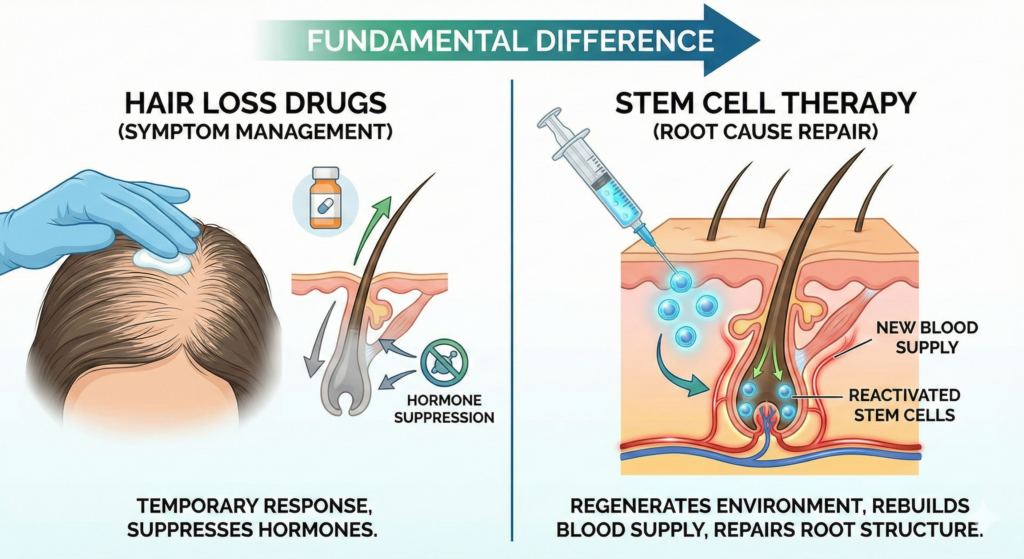
Here is what these treatments all have in common: they manage symptoms. Every FDA-approved hair loss drug either suppresses DHT or artificially stimulates blood flow. Stop the drug, and the hair loss resumes—often faster than before. None of them repair the damage already done to your follicles. According to published research, substantial improvement is observed in no more than 20% of patients on standard pharmacological treatments for AGA and FAGA. For many, years of daily medication produce only modest results while side effects accumulate.
Stem cell therapy is fundamentally different. It doesn’t suppress a hormone or force a temporary response. It regenerates the follicle environment itself—rebuilding blood supply, reactivating dormant stem cells, and repairing the damaged structures at the root of each hair.
This is the critical distinction that sets our approach apart from every drug on the market: we are not asking your body to temporarily change its chemistry. We are providing your follicles with the biological building blocks—living cells, growth factors, and regenerative signals—they need to repair themselves from within.
At Cell Grand Clinic in Osaka, Japan, we deliver 100 to 200 million of your body’s own adipose-derived (fat-derived) stem cells—directly to your scalp and via IV infusion. No hormones. No daily pills. No lifetime prescriptions. Just drug-free regeneration using your own biology. This is the latest advancement in hair loss treatment, and it’s available now.
What Are AGA and FAGA? Why Your Follicles Aren’t Dead
Androgenetic Alopecia (AGA) is genetically driven hair loss—commonly known as male pattern baldness. In women, it’s called Female Androgenetic Alopecia (FAGA) or female pattern hair loss. By age 50, roughly half of all men and nearly 40% of women experience noticeable thinning, and many notice changes as early as their late 20s.
Here’s what’s happening beneath the surface: dihydrotestosterone (DHT) binds to receptors in genetically susceptible follicles and gradually shrinks them. The growth phase (anagen) shortens cycle by cycle until each hair becomes too thin and short to see.
But here’s the critical point: in most AGA and FAGA cases, the follicle stem cells are still alive. They’re miniaturized and dormant—not dead. Research published in the Journal of Clinical Investigation confirmed that even in bald scalps, follicle stem cells remain present in the bulge region (Garza et al., 2011). They simply lack the right signals to reactivate.
This is precisely why stem cell therapy works—and why drugs that only block DHT can never fully reverse the damage.
Drugs vs. Stem Cells: Why Symptom Management Will Never Be Enough
Understanding the fundamental difference between drug treatments and stem cell therapy is crucial to making an informed decision about your hair.
| Finasteride | Minoxidil | Stem Cell Therapy | |
| Mechanism | Suppresses DHT (symptom control) | Dilates scalp blood vessels | Regenerates follicle environment |
| Duration of Use | Lifelong daily pill | Lifelong twice-daily topical | 1–2 sessions; annual maintenance |
| Side Effects | Sexual dysfunction, depression, brain fog | Scalp irritation, unwanted facial hair | Temporary redness at injection site |
| For Women? | Contraindicated in pregnancy | Limited efficacy in women | Safe and effective for FAGA |
| Repairs Follicles? | No — suppresses only | No — surface stimulation | Yes — rebuilds blood supply, reactivates stem cells |
| After Stopping | Hair loss resumes/accelerates | Hair loss resumes | Regenerative effects persist |
The bottom line: drugs suppress a symptom (DHT). Stem cells repair the underlying damage—regenerating blood vessels, reactivating dormant follicle stem cells, and thickening each individual hair shaft. One is a band-aid; the other is actual repair.
How Stem Cell Therapy Reverses Hair Loss: The Science, Made Simple
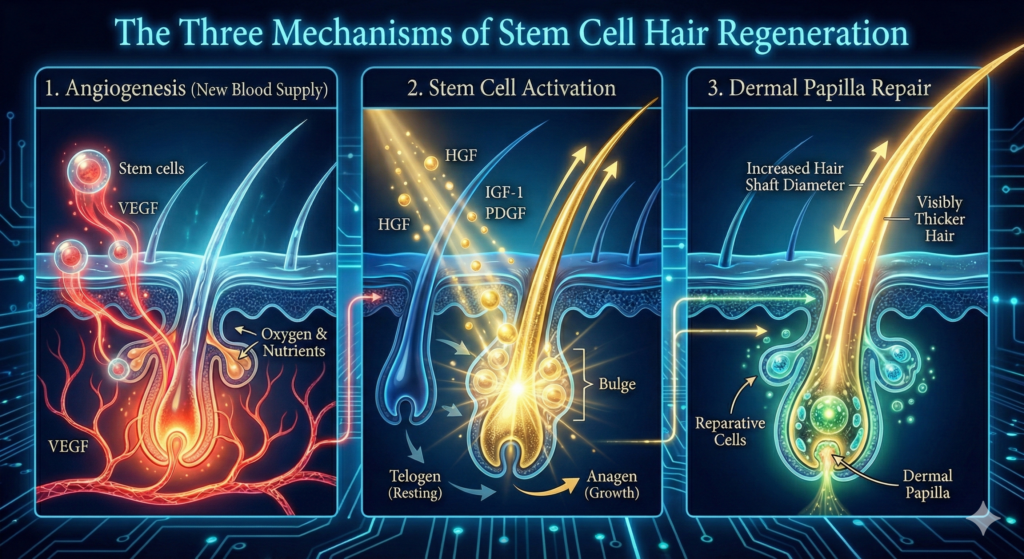
Think of your hair follicle as a tiny garden. AGA destroys it in three ways: it cuts off the water supply (blood flow), puts the seeds to sleep (stem cell dormancy), and weakens the soil (dermal papilla damage). Our stem cell treatment addresses all three simultaneously.
1. Rebuilding Blood Supply (Angiogenesis)
Your stem cells release VEGF (Vascular Endothelial Growth Factor), which builds brand-new capillaries around starving follicles. Research in the Journal of Clinical Investigation confirms VEGF is essential for follicle growth and cycling (Yano et al., 2001). More blood means more oxygen and nutrients—the basic fuel your hair needs.
2. Reactivating Dormant Follicles
The stem cells secrete a cocktail of growth factors—including HGF, IGF-1, and PDGF—that signal dormant follicle stem cells to shift from the resting phase (telogen) back into active growth (anagen). This is something no oral medication can do. Drugs block DHT from causing further damage; stem cells actually reverse the dormancy that’s already occurred. The Garza et al. study in the Journal of Clinical Investigation (2011) demonstrated that even completely bald scalps retain stem cells in the follicle bulge—they simply lack the specific CD200-rich and CD34-positive progenitor signals needed to reactivate. Our treatment delivers exactly those regenerative signals at therapeutic concentrations.
3. Repairing the Dermal Papilla
The dermal papilla at the base of each follicle acts as its command center. In AGA, DHT gradually damages these cells over years. Stem cell therapy repairs them, producing not just more hairs but thicker, stronger individual hairs—a qualitative improvement that drugs simply cannot achieve.
➤ Book Your Private Consultation
Clinical Evidence: What Peer-Reviewed Research Shows
Our approach is grounded in published clinical trials—not marketing claims.
Randomized Controlled Trial (Tak et al., 2020) — STEM CELLS Translational Medicine
This landmark double-blind study found a 28.1% increase in hair count using adipose-derived stem cell constituents, with zero serious adverse effects reported. Results were statistically significant at the 8-week mark.
Systematic Review of 12 RCTs (Gasteratos et al., 2024) — PRS Global Open
Analysis of 514 AGA patients across 12 randomized controlled trials confirmed that both cellular and acellular stem cell therapies are safe and effective. The review also found that adipose tissue yields 100–1,000 times more stem cells than bone marrow—which is precisely why we use adipose-derived cells exclusively.
Efficacy in Women (Shin et al., 2015) — International Journal of Dermatology
A study of 27 women with FAGA showed a 16.4% increase in hair density after just 12 weeks. This finding is especially significant because women have far fewer approved treatment options than men.
Why Adipose-Derived Stem Cells? Not All Stem Cells Are Equal
You may see clinics offering stem cell therapy using bone marrow, cord blood, or even plant-derived extracts. The source matters enormously. Adipose tissue produces 100–1,000 times more mesenchymal stem cells than bone marrow (Zuk et al., 2002). It requires only a minimally invasive harvest—about 10ml of fat from the abdomen under local anesthesia, which most patients describe as less uncomfortable than a dental procedure. And because these are your own cells, there is zero risk of immune rejection or allergic reaction. Unlike bone marrow aspiration, which requires a needle into the hip bone and can be significantly painful, fat harvest is quick, gentle, and leaves virtually no scarring.
The 2024 systematic review by Gasteratos et al. confirmed adipose tissue as the most abundant, accessible, and potent source for regenerative hair therapy. Plant-based and synthetic “stem cell” products—despite their marketing language—contain no actual living stem cells and cannot replicate the regenerative mechanisms of genuine autologous cell therapy. Similarly, exosome-only treatments lack the full spectrum of living cell activity that cultured adipose stem cells provide.
▶More information about stem cell
Your Treatment at Cell Grand Clinic: Step by Step
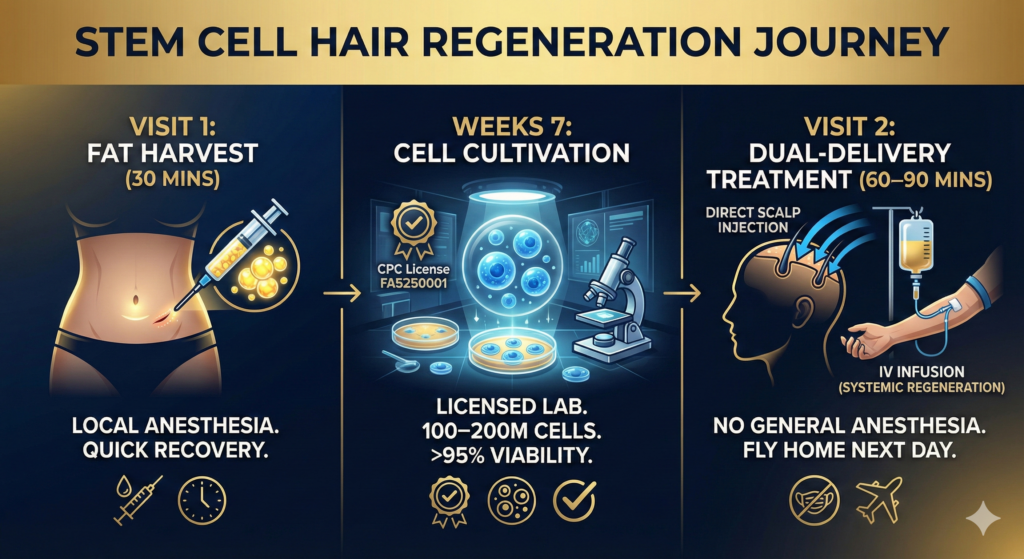
Our protocol is designed specifically for international patients. The entire process requires just two visits to Osaka, approximately 2–3 weeks apart.
Visit 1: Fat Harvest (30 Minutes)
Under local anesthesia, approximately 10ml of fat is extracted from your abdomen through a small incision. You can resume normal activities the same day.
Weeks 7: Cell Cultivation in Our Licensed Laboratory
Your tissue is transported to our government-certified Cell Processing Center (CPC License: FA5250001), where stem cells are isolated and cultured to reach 100 to 200 million cells with over 95% viability. Every batch is tested for sterility, viability, and potency before treatment.
Visit 2: Dual-Delivery Treatment Day
Direct Scalp Injection delivers stem cells precisely into the dermal papilla layer—exactly where follicle regeneration needs to happen. This targeted approach maximizes concentration where it matters most. IV Infusion (optional but recommended) delivers stem cells systemically, supporting vascular health and overall regeneration. Many patients combine scalp treatment with broader anti-aging benefits. Total treatment time: approximately 60–90 minutes. No general anesthesia. No hospitalization. Fly home the next day.
➤ Book Your Private Consultation
Why Japan — and Why Cell Grand Clinic?
Japan’s Regulatory Advantage
Japan is the only major country with a dedicated national law for regenerative medicine. The Act on the Safety of Regenerative Medicine (2014) requires every stem cell treatment to be government-approved before patient administration, processed in licensed pharmaceutical-grade facilities, and reported to a national safety database for ongoing surveillance. This means every treatment we provide is tracked, audited, and subject to national-level quality control. Many stem cell tourism destinations in Southeast Asia, Central America, and Eastern Europe operate without comparable oversight—lower prices often reflect absent safety standards, not better value.
Cell Grand Clinic holds 10 Type II Government Licenses — the highest outpatient classification issued by Japan’s Ministry of Health, Labour and Welfare.Why Japan—and Why Cell Grand Clinic
World-Class Scientific Partnership
Your stem cells are cultured at a government-certified Cell Processing Center (CPC License: FA5250001) connected to the research of Professor Takahiro Ochiya of Tokyo Medical University — a Web of Science Top 0.1% Highly Cited Researcher for six consecutive years, with over 800 peer-reviewed publications and 57,000+ citations. His pioneering exosome research directly informs the cultivation protocols used on your cells. This caliber of academic-clinical partnership is virtually unheard of in the private regenerative medicine sector anywhere in the world.
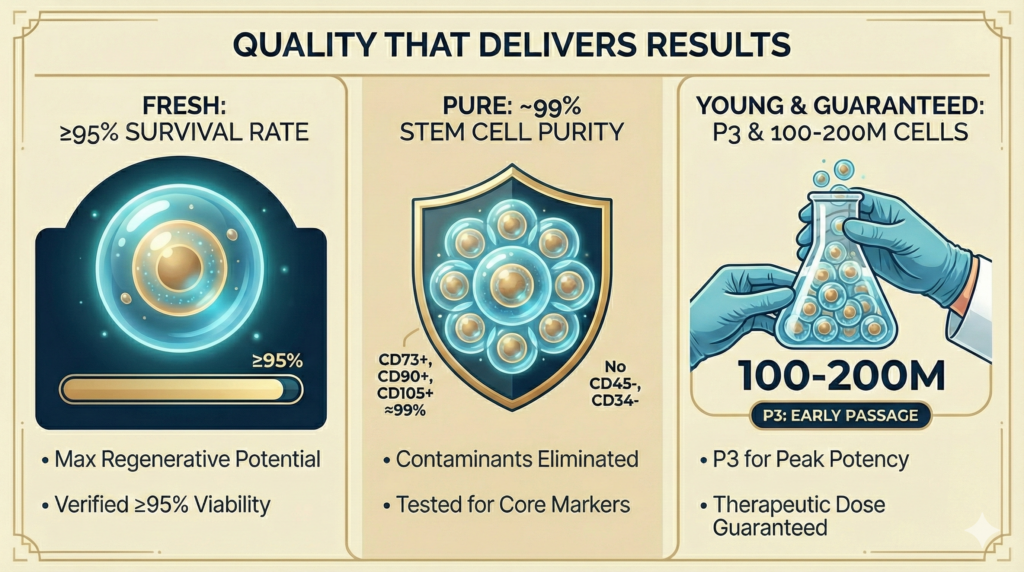
Cell Quality Standard: Fresh, Pure, Young
Many clinics offer a few million cells—doses too small for systemic effect. We invest 7 weeks cultivating your cells to a maximum of 200 million viable cells (2×10⁸). Every batch is over 95% survival rate, only early-passage (P3) cells for maximum potency, tested for sterility and genetic stability. Our philosophy: “Fresh, Pure, Young”—
| Quality Pillar | Our Standard | Why It Matters |
| FRESH | 95%+ cell survival rate | Higher survival rate = greater regenerative and repair potential. Dead or dying cells cannot heal. Cell Viability ≥95% (verified before every administration) vs. industry average of 70–85% |
| PURE | ~99% stem cell surface antigen expression | CD73+, CD90+, CD105+ expression ≈99%; CD45−, CD34− (contaminants eliminated) vs. many clinics that do not test |
| YOUNG | Passage 3 cultivation; never over-expanded | Early-passage cells maintain maximum differentiation ability and biological activity. Over-passaged cells lose potency. Guaranteed 100 million cells at P3 vs. competitors using P5+ with reduced potency |
| GUARANTEED DOSE | 100 to 200 million cells per administration guaranteed | Therapeutic dosing matters. Insufficient cell counts mean insufficient results. |
Your Doctor: A Physician-Scientist Who Speaks Your Language
Dr. Yuichi Wakabayashi, M.D., Ph.D. brings credentials that bridge East and West. He completed postdoctoral training at the National Institutes of Health (NIH) in the United States. He is the first author on a Pfizer-collaborated world-first PET tracer study published in the Journal of Nuclear Medicine (2022), a Diplomate of the American Board of Regenerative Medicine (ABRM), and was featured in The Wall Street Journal as a “Next Era Leader.” Critically, Dr. Wakabayashi is fluent in English, allowing direct doctor-patient communication with no interpreters needed.
What to Expect: Your Results Timeline
| Timeframe | What to Expect |
| Weeks 1–4 | Reduced shedding; early signs of follicle reactivation beginning at the cellular level. |
| Weeks 4–12 | New fine hairs (vellus) emerging; existing hairs may begin to feel thicker. |
| Months 3–6 | Visible improvement in density and thickness. Clinical trials show statistically significant results by week 8–16. |
| Months 6–12 | Peak results—fuller, thicker, stronger hair. Many patients report the improvement continues beyond the 6-month mark. |
| 12+ Months | Sustained results. Annual maintenance treatment recommended for long-term optimization. |
Individual results vary depending on the degree of hair loss, overall health, and genetics. Patients with earlier-stage AGA/FAGA typically see the most dramatic improvements—another reason not to delay.
Who Is the Ideal Candidate?
Best Candidates:
Men and women with early-to-moderate AGA/FAGA (Norwood II–V; Ludwig I–II).
Patients experiencing medication side effects who want a drug-free path.
Women with FAGA who have few approved options.
Those who want to combine hair regeneration with anti-aging benefits.
Patients considering a transplant who want to maximize follicle health first.
International patients seeking world-class regenerative treatment under Japan’s rigorous regulatory framework.
➤ Book Your Private Consultation
May Not Be Ideal For:
Complete baldness (Norwood VII)—if follicles are entirely fibrosed, too few viable cells may remain for meaningful reactivation.
Scarring alopecia (cicatricial)—these conditions destroy follicle structures permanently and require different treatment approaches.
Hair loss caused primarily by nutritional deficiencies or thyroid disorders should be addressed with appropriate medical treatment first, though stem cell therapy can complement these approaches once underlying conditions are managed.
During your free consultation, Dr. Wakabayashi will provide an honest evaluation. If stem cell therapy isn’t the best option for you, we’ll say so directly.
Beyond Hair: Anti-Aging Benefits of Stem Cell Therapy
Many of our international patients are already interested in longevity medicine. The same adipose-derived stem cells used for hair regeneration have documented benefits throughout the body. When delivered via IV infusion alongside scalp injection, stem cells can support improved vascular health and endothelial function, increased collagen production and skin elasticity, reduced systemic inflammation and enhanced tissue repair, and improved energy, sleep quality, and overall vitality. Published research in the field of regenerative medicine consistently demonstrates that mesenchymal stem cells from adipose tissue release anti-inflammatory cytokines and growth factors that benefit multiple organ systems simultaneously.
This is why our dual-delivery protocol—scalp injection plus IV infusion—is especially popular with patients addressing hair loss as part of a broader regenerative health strategy. Rather than treating hair loss in isolation, you are investing in whole-body cellular renewal. Many of our patients report noticeable improvements in skin texture, joint comfort, and general well-being within weeks of treatment—benefits that no hair loss pill has ever delivered. Cell Grand Clinic holds government licenses for multiple stem cell applications, making us one of the most comprehensively approved regenerative medicine clinics in Japan.
Addressing Common Concerns
“The FDA hasn’t approved this.”
Correct—the FDA regulates treatments within the United States. Japan has its own rigorous framework specifically designed for regenerative medicine. We hold 10 government licenses under this framework. We operate under one of the world’s most stringent regenerative medicine laws.
“The studies are too small.”
Individual studies are modest in size, but the 2024 systematic review aggregated 12 RCTs and 514 patients, finding consistent evidence of safety and efficacy. The evidence base is growing rapidly, and importantly, zero serious adverse effects have been reported across all published trials.
“Can’t I just get PRP instead?”
PRP delivers concentrated platelets—no actual stem cells. Our treatment delivers 100–200 million living, cultured stem cells with a full spectrum of growth factors. PRP is watering a struggling garden; stem cell therapy is replanting it with healthy new growth.
Frequently Asked Questions
Is the treatment painful?
The fat harvest uses local anesthesia—most patients compare it to having blood drawn. Scalp injections use fine needles with topical numbing. The vast majority describe the experience as very tolerable.
Can women receive this treatment?
Absolutely. Unlike finasteride, stem cell therapy is safe for women. The Shin et al. study specifically demonstrated significant hair density improvement in women with FAGA.
How does this compare to hair transplant surgery?
Transplants move existing hair—they don’t create new growth. Stem cell therapy regenerates dormant follicles. Many patients pursue stem cell therapy before or instead of a transplant, and the two can be complementary.
How long do results last?
Studies show effects lasting 6–12+ months. We recommend annual maintenance for sustained results. Because stem cell therapy addresses the root cause rather than symptoms, many patients find their results more durable than drug-based treatments.
I live outside Japan. How does the process work?
Two visits to Osaka (1–2 days each), approximately 2–3 weeks apart. Our concierge team assists with scheduling, hotels, and airport transfers. Dr. Wakabayashi conducts all consultations and treatments in English.
Is this really the latest treatment for AGA and FAGA?
Autologous adipose-derived stem cell therapy represents the cutting edge of regenerative medicine for hair loss. A growing body of clinical evidence—including RCTs and systematic reviews in leading peer-reviewed journals—supports this as one of the most advanced approaches currently available, with an established safety record and legal approval under Japan’s regenerative medicine framework.
What is the cost?
Pricing depends on your treatment plan: 100 million vs. 200 million cells, scalp injection alone vs. combination with IV infusion. We provide transparent pricing during your free consultation. While stem cell therapy is a premium treatment, many patients find it cost-effective compared to years of accumulated drug costs, repeated PRP sessions, or expensive hair transplant surgeries that don’t address the underlying cause of hair loss.
Can I combine stem cell therapy with other treatments?
Yes. Stem cell therapy works synergistically alongside low-level laser therapy and topical treatments. Some patients also combine it with hair transplant surgery for maximum results. Dr. Wakabayashi will recommend the optimal combination for your specific situation during your consultation.
Take the First Step
Hair loss is progressive. Every month of delay means fewer dormant follicles that can be saved.
The earlier you act, the more follicles remain in a dormant—rather than permanently fibrosed—state. Patients who begin stem cell therapy at early-to-moderate stages consistently achieve the most dramatic improvements. Waiting until hair loss is advanced significantly reduces the number of follicles available for reactivation.
Cell Grand Clinic offers complimentary consultations for international patients considering stem cell therapy for AGA or FAGA. Dr. Wakabayashi will review your medical history and hair loss pattern, explain whether you’re a candidate, provide a personalized treatment plan with transparent pricing, and answer all questions in English—directly, with no interpreters needed.
➤ Book Your Private Consultation
Contact Us:
Location: Shinsaibashi, Osaka, Japan
Website: cellgrandclinic.com
Languages: Japanese & English
International patients welcome